Blog
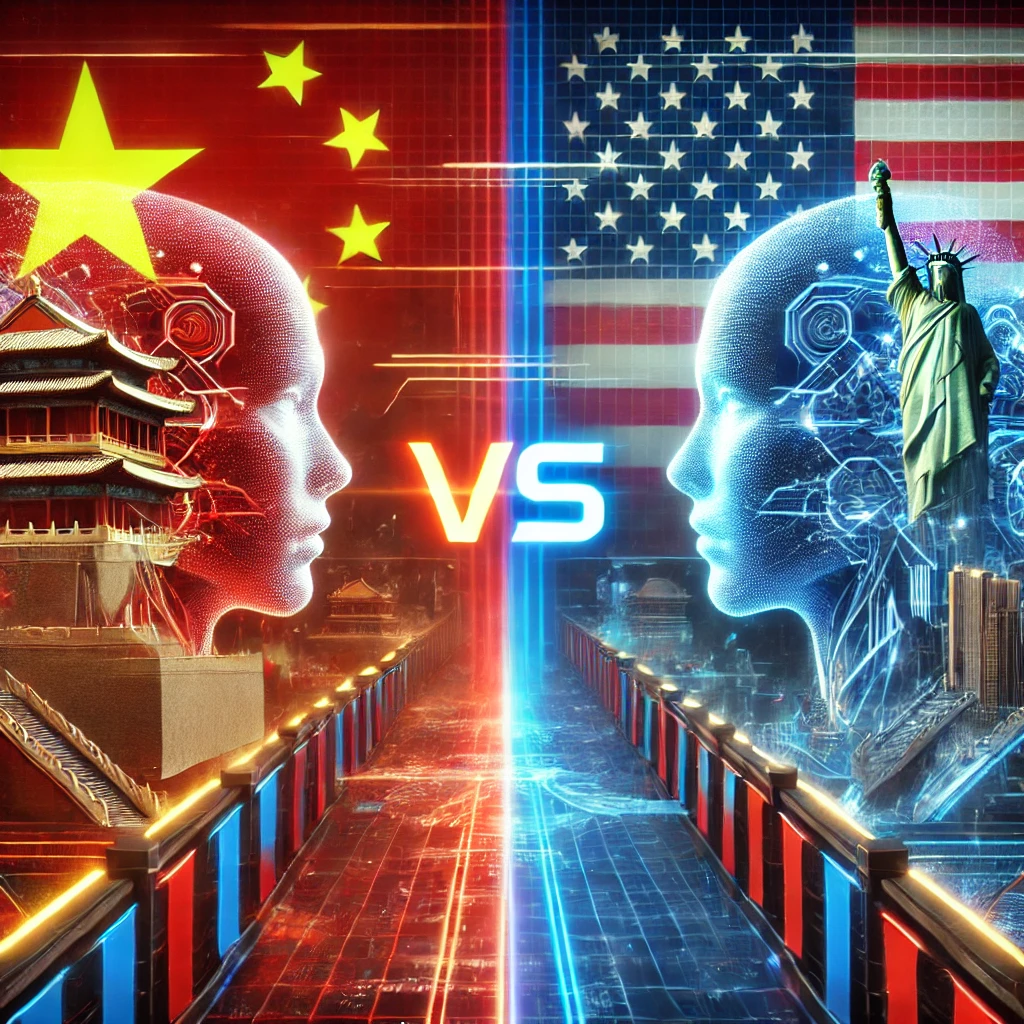
China vs. the US: Who Will Win the Battle for 🧠 AI Hegemony? 🌍🤖
In three steps, discover how this rivalry is shaping the future of AI.
The battle for global AI dominance is intensifying. As nations race to harness the transformative power of artificial intelligence, two giants are emerging as the frontrunners: the United States and China. The US is home to pioneers like OpenAI and Google DeepMind, while China counters with state-backed tech giants such as Baidu and Tencent. But who is truly leading this technological race?
🇨🇳 China: AI Driven by Data and Policy
China’s AI strategy is deeply intertwined with the country’s vast access to data and robust government policy support. With over a billion internet users, China boasts an unparalleled wealth of data that fuels the development of powerful AI systems. These large datasets enable Chinese companies to rapidly advance AI technologies, making them key players in the global AI race.
One standout example is DeepSeek R1, a cutting-edge reasoning AI model. Early reports suggest that it outperforms OpenAI’s models, setting a new benchmark for AI systems. This shows China’s ambition to not only compete with the West but to surpass existing benchmarks in AI performance. The Chinese government also plays a pivotal role in this drive by fostering a policy environment that supports the development of AI through massive investments in both private and public sectors.
China is not just aiming for technological supremacy in consumer-facing AI solutions; it’s integrating AI into military applications and economic strategies. The goal is clear: AI will be the cornerstone of China’s next-generation infrastructure, economic growth, and global influence. In this centralized, top-down approach, speed and scalability are prioritized, allowing China to move quickly, adapt, and leverage AI as a strategic asset on the world stage.
🇺🇸 US: Innovation Through Competition
In contrast, the United States has long been a hub of innovation in AI, driven by its culture of competition, entrepreneurship, and a thriving ecosystem of startups. Companies like OpenAI and Google DeepMind have produced some of the world’s most advanced AI models, such as OpenAI’s GPT series and DeepMind’s AlphaFold. These models have revolutionized industries like healthcare, natural language processing, and robotics.
Unlike China, the US model is characterized by decentralized innovation, with both private companies and academic institutions contributing to advancements in AI. OpenAI’s GPT models, for instance, have set the standard in natural language processing, while Meta’s LLaMA models provide an open-source alternative that challenges traditional, proprietary systems. This culture of open-source collaboration and healthy competition fosters continuous breakthroughs, ensuring that AI development remains dynamic and innovative.
The US government also plays a crucial role but in a different way. While the US supports AI development through funding and research programs, there is less centralized control compared to China. This open environment encourages a diversity of approaches, leading to rapid progress across a variety of sectors. However, it also means that the US must contend with increasing challenges, such as the ethics of AI, regulatory frameworks, and international competition.
⚔️ Who Will Win?
Both nations are on distinct paths, each offering a unique route to AI dominance.
China’s centralized approach offers unmatched speed and scalability, allowing it to push AI solutions into all areas of life, from governance to commerce and defense. With strong government backing, China’s AI development is strategic, aiming for long-term global supremacy in AI-powered industries.
On the other hand, the US’s model of innovation through competition emphasizes creativity and flexibility. It thrives on decentralized innovation, with private companies and research institutions driving the technological breakthroughs. This approach fosters a more open and competitive environment, encouraging rapid advancements in AI across diverse fields.
So, who will emerge victorious in the battle for AI hegemony? In the short term, China’s centralized approach may provide it with the advantage in terms of scale and integration. However, the US’s open, competitive culture has the potential to lead to more diverse and adaptable AI solutions. Both countries are poised to play key roles in shaping the future of AI—China with its strategic use of data and policy, and the US through continuous innovation.
Ultimately, the race for AI supremacy will not only shape the technological landscape but will also determine the future of global power. As AI continues to evolve, it will be interesting to see how these two nations navigate the ethical, political, and economic challenges that come with such a powerful technology.