🧬
MindAdapt LAB
Epigenetics & Multi-Omics Structured
Developed by MindAdaptAI
MindAdapt Database. An early biological detection and decision system for proactive disease risk management.
Research initiative by Mario Heijenk
AI Engineer & Healthcare AI Researcher
MindAdapt.DB uncovers how genes respond to lifestyle, environment, and treatment, revealing early signs of Type 2 Diabetes before symptoms appear. Our AI organizes risk into clear categories—High ⚠️ High, 🔴 Medium, 🟡 Low, 🟢 Very Low,—so clinicians can quickly identify at-risk patients. This enables immediate, tailored action: from monitoring and prevention to timely interventions when needed, making care smarter, faster, and more personal.
Core Statement:
Epigenetics research, MindAdapt.DB translates early biological signals into actionable insights for prevention, without replacing clinical judgment.
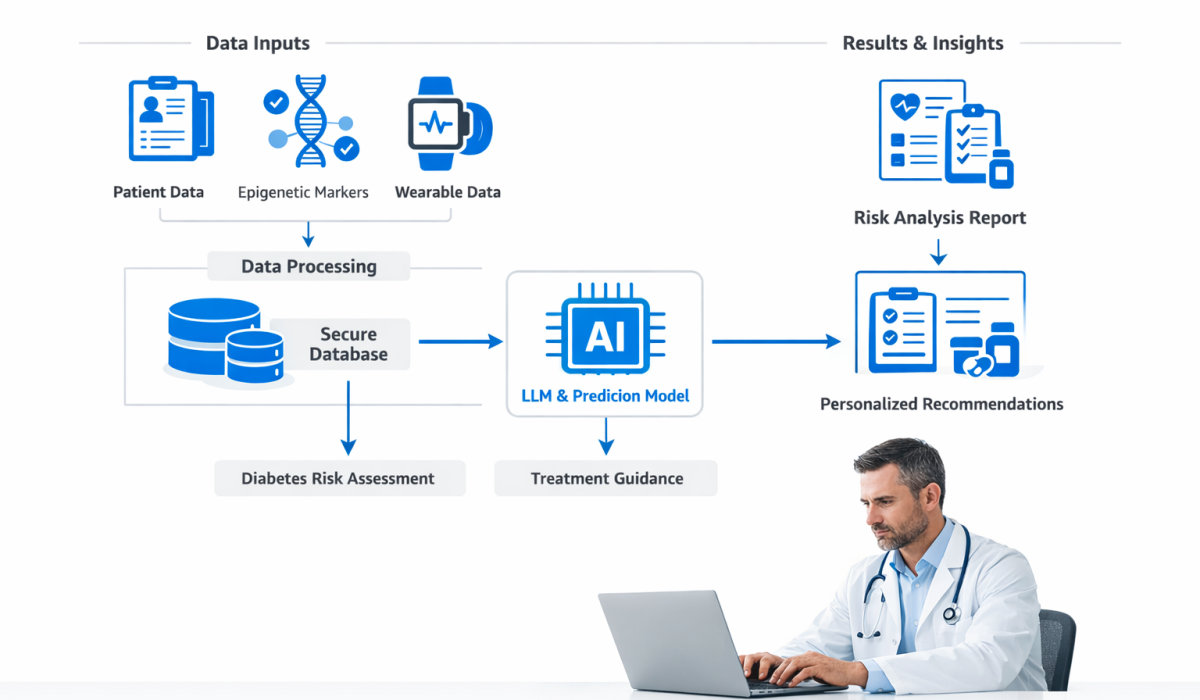
MindAdapt.DB – Early Type 2 Diabetes Research
MindAdapt.DB is a secure, fully open-source research database that leverages anonymized patient-derived datasets. No identifiable patient information is used, ensuring privacy while enabling analysis of gene expression and epigenetic patterns.
Disclaimer: MindAdapt.DB is intended for research purposes only. Analyses are based on anonymized, open-source datasets, and future studies may reveal additional patterns. Results are not a substitute for clinical judgment.
| Status | Public on Jan 17, 2024 |
| Title | Interactions between insulin resistance, epigenetics, and donor sex in control of gene expression in human iPS cell-derived myoblasts |
| Organism | Homo sapiens |
| Experiment type | Expression profiling by high throughput sequencing |
| Summary | About 25% of people within the general population are insulin resistant, increasing the risk for type 2 diabetes (T2D) and metabolic disease. Transcriptomic analysis of iPS cells differentiated into myoblasts (iMyos) from insulin resistant (I-Res) versus insulin sensitive (I-Sen) non-diabetic individuals reveals 306 genes increased and 271 genes decreased in expression in iMyos from insulin resistant donors with differences of 2-folds or more. Over 30 of the genes changed in I-Res iMyos are associated with T2D by SNP polymorphisms and functionally linked to insulin action and control of metabolism. Interestingly, we also identified >1500 differences in gene expression that were dependent on sex of the cell donor, some of which modified the insulin resistance effects. Many of these sex-differences were associated with increased DNA methylation in cells from females and reversed by 5-azacytidine. By contrast, the insulin sensitivity differences were not reversed and thus appear to reflect genetic or methylation-independent epigenetic effects. Dataset used in our analysis: https://www.ncbi.nlm.nih.gov/gds/?term=epigenetics+diabetes https://www.ncbi.nlm.nih.gov/geo/query/acc.cgi?acc=GSE244307 |
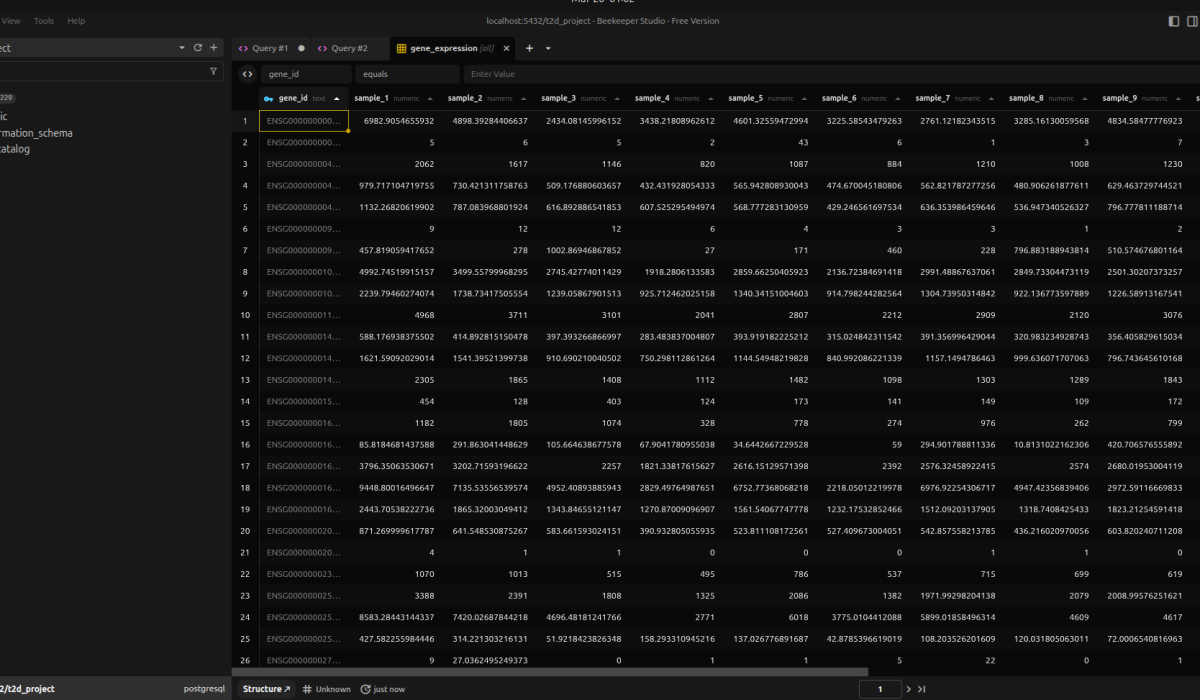
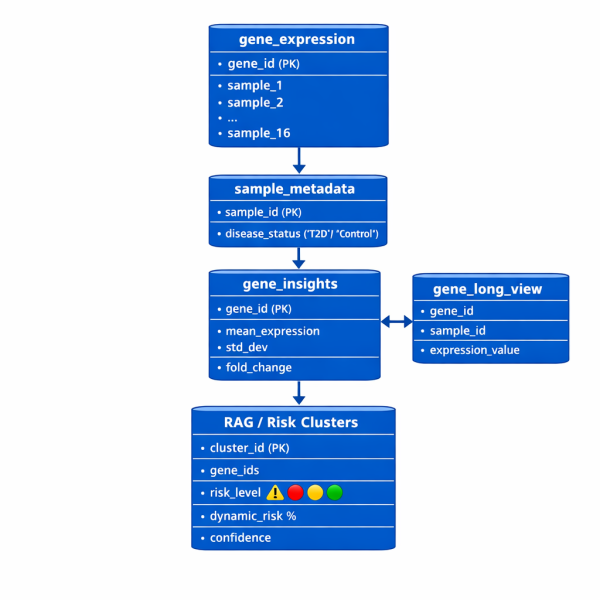
MindAdapt.DB –epigenetics-database-architecture
Most AI-driven diabetes solutions rely on large-scale patient data and complex, often black-box models. While powerful, these approaches can be difficult to interpret and are not always practical for smaller clinical settings.
MindAdapt.DB takes a different approach. It translates complex gene expression and epigenetic signals into clear, clinically relevant insights—without requiring large datasets or opaque AI models. By analyzing biological patterns, it identifies early signs of Type 2 Diabetes risk before symptoms appear.
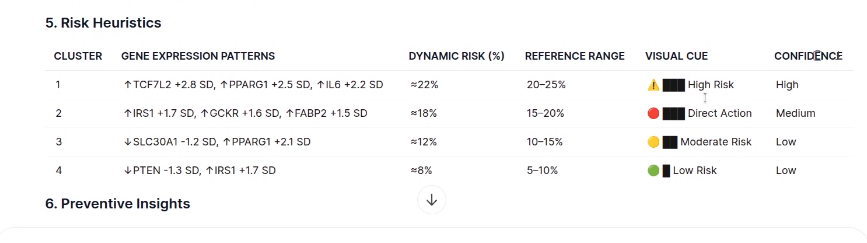
Patterns are grouped into simple risk categories (⚠️ High, 🔴 Medium, 🟡 Low, 🟢 Very Low), making underlying mechanisms easy to understand and act upon. This enables clinicians to recognize at-risk patients earlier and support targeted prevention, while keeping clinical judgment central.
Early Type 2 Diabetes Risk – Key Insights Backed by Science
1. Detect Early Risk
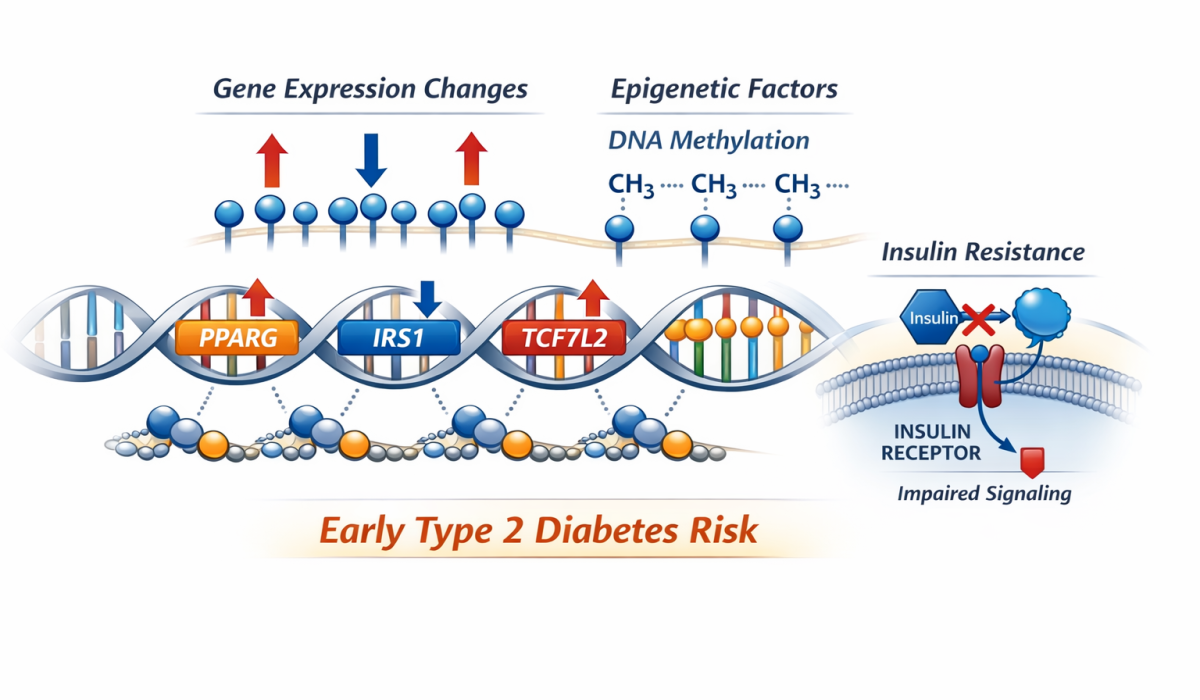
Research shows that specific patterns of gene activity and DNA methylation—key biological signals—can reveal increased Type 2 Diabetes risk well before any clinical symptoms appear.
https://www.nature.com/articles/s41598-024-64846-3.
2. Analyze and Cluster
MindAdapt.DB integrates multi-omics data across genes, measuring expression, variation, and fold changes, and organizes these key biological signals into clear risk clusters for intuitive interpretation.
3. Translate into Action
These clusters highlight the mechanisms behind insulin resistance and inflammation, helping clinicians identify at-risk patients early and support focused, personalized prevention strategies, while keeping clinical judgment central.
Understanding Gene Expression in Type 2 Diabetes
We analyze gene activity in individual donors to uncover mechanisms behind insulin resistance. Each gene is measured across donor samples, with values representing expression levels, while metadata capture characteristics such as insulin sensitivity. This setup allows us to link specific gene patterns to early risk and potential biomarkers.
Leading AI in Early Type 2 Diabetes Detection
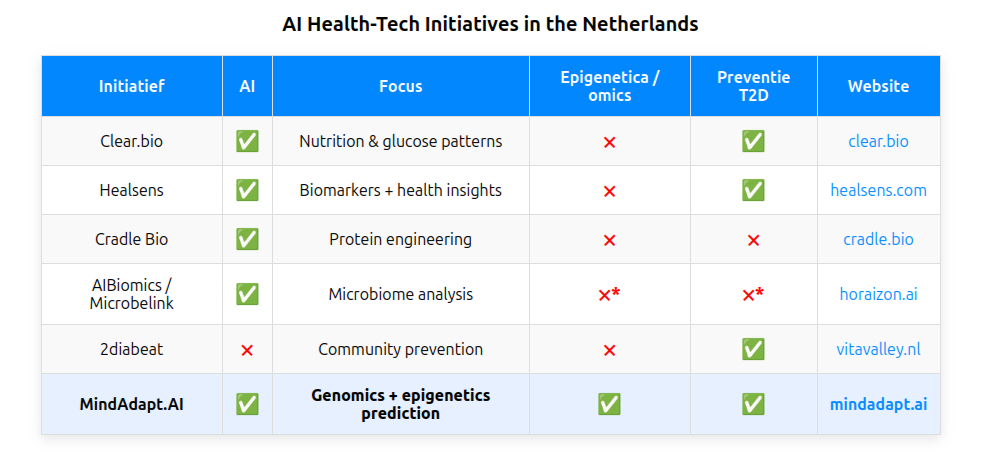
While many AI health-tech initiatives focus on diabetes, nutrition, and general prevention,
we focus on underlying biological mechanisms — the root drivers of disease.
By integrating interpretable, multimodal data, we help clinicians identify at-risk patients earlier and guide targeted preventive interventions.
Built on validated datasets and emerging research, we bring precision medicine to clinical practice—enabling earlier decisions, precise interventions, and better patient outcomes.
Future Directions & Project Goal
MindAdapt.DB currently uses only open-source data, with the future option to safely integrate fully anonymized clinical data. Our goal is to combine AI, open-source models, and local processing to deliver actionable insights for early T2D prevention—research that is clinically applicable.
Beyond Diabetes
By focusing on shared mechanisms like inflammation and metabolic imbalance, MindAdapt.DB can detect patterns in metabolic syndrome, cardiovascular disease, and chronic inflammatory disorders. Key genes such as IL6 and TNFα show similar signals, enabling a unified approach to understanding complex diseases.
Important to Know
AI outputs are for research purposes only and do not replace clinical judgment.
Epigenetic changes can reveal risk years before diagnosis.
Results must be critically reviewed and further validated in larger, long-term studies.
Core Statement:
MindAdapt.AI translates early biological signals into actionable insights for prevention, without replacing clinical judgment.