Blog
Privacy, Compliance & Governance-First
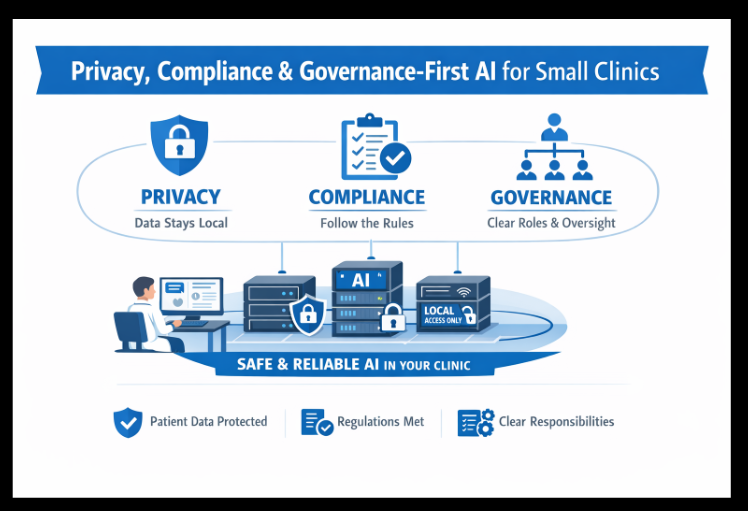

Privacy, Compliance & Governance-First AI for Small Clinics
Small clinics face a tricky balance: using AI to improve care, while protecting sensitive patient data and staying compliant with regulations. Many think AI requires big hospitals or cloud services—but the key is adopting a Privacy, Compliance & Governance-First strategy.
The Challenge for Small Clinics
Imagine this: a doctor wants AI to summarize patient notes, suggest treatment options, or check the latest diabetes research—but the clinic has limited staff and resources.
Most AI systems are cloud-based, which creates three main risks:
Privacy risk: Sending patient data to external servers can expose it.
Analogy: Like mailing your house keys to a neighbor just to check your mailbox.Compliance risk: Clinics must follow rules like GDPR, HIPAA, or NEN 7510. Mistakes can be costly.
Analogy: It’s like building a playground without checking safety regulations—you can get in serious trouble.Governance risk: Without clear roles, policies, and oversight, AI projects can fail or create hidden problems.
Analogy: Running a kitchen where everyone cooks at once, without a recipe or assigned tasks—it ends in chaos.
Pillar 1: Privacy
Keeping patient data local is the first step.
Data stays in the clinic: AI runs on local computers (or small clusters), not in the cloud.
Encryption & access controls: Only authorized staff can see sensitive information.
Practical example: Using AI to summarize patient notes is like having a trusted assistant in your office—it reads your files, but never leaves the room.
Pillar 2: Compliance
Even with local AI, clinics need to follow healthcare regulations.
Know the rules: GDPR, HIPAA, and national standards like NEN 7510.
Document everything: Keep simple logs of what data is processed and how.
Practical example: Before running AI on patient files, think of it as checking a recipe before cooking—you make sure it’s safe, complete, and follows the instructions.
Pillar 3: Governance
Good governance ensures AI is used responsibly and effectively.
Assign roles: Doctors (data owners), IT staff (system managers), and privacy officers (oversight).
Logging and backups: Track AI usage and protect against accidental errors.
Practical example: Like a fire drill plan in your office—everyone knows what to do if something goes wrong.
With governance, clinics can confidently scale AI gradually, even with limited resources, without risking patient safety or breaking regulations.
Putting It Together: Why It Matters
A Privacy, Compliance & Governance-First strategy lets small clinics:
Protect sensitive patient data
Reduce the risk of regulatory violations
Ensure AI is trustworthy and reliable
Experiment safely with AI tools for tasks like documentation, patient guidance, or research review
Analogy: Think of local AI like a smart, responsible assistant in your clinic—it helps with tasks, follows all rules, and never leaves the office with your secrets.
The Netherlands
https://www.edpb.europa.eu/edpb_en
https://eur-lex.europa.eu/eli/reg/2016/679/oj
https://autoriteitpersoonsgegevens.nl/
https://www.nen.nl/nen-7510-nl-26326
https://www.hhs.gov/hipaa/for-professionals/index.html
Brazil.
https://www.gov.br/g20/en/lgpd?utm_source=chatgpt.com
https://lgpd-brazil.info/chapter_02/article_11?utm_source=chatgpt.com
https://www.atlassian.com/nl/trust/privacy/country/brazil-and-lgpd?utm_source=chatgpt.com